How zeolite rotor concentration plus regenerative thermal oxidation treats dilute, high-volume VOC streams, with 97–99.5% efficiency by configuration.
Waste gas with low VOC concentration but large air volume is one of the harder streams to treat: oxidizing it directly would need an enormous amount of fuel just to heat the carrier air. The combination of zeolite molecular sieve rotor concentration with a regenerative thermal oxidizer (RTO) is designed for exactly this case.
How the combined system works
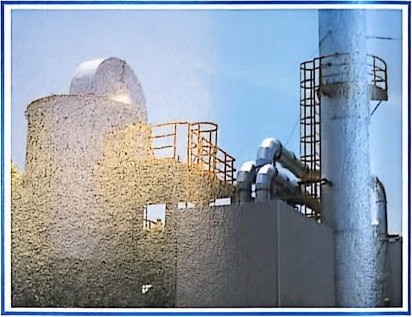
The incoming low-concentration, high-volume organic waste gas passes through a zeolite rotor that concentrates the VOC 10 to 15 times. The concentrated stream is then heated to 760°C, at which point the VOC oxidizes and decomposes into harmless CO₂ and H₂O. The heat of the high-temperature gas is stored in the media inside the RTO and used to preheat the incoming gas, which saves most of the fuel that preheating would otherwise consume.
The six sections of a complete system
- Waste gas pre-treatment.
- Zeolite molecular sieve adsorption.
- Desorption.
- Drying and cooling.
- RTO post-treatment.
- Automatic control.
Efficiency depends on the RTO configuration
| Configuration | Purification efficiency |
|---|---|
| Two-chamber RTO | 97–99% |
| Three-chamber RTO | 97–99% |
| Rotary RTO | up to 99.5% |
Both multi-chamber and rotary forms are standard configurations. The rotary RTO reaches the highest efficiency in a single vessel, while chamber designs remain the common choice across general applications.
When this route fits
The zeolite rotor + RTO route is aimed at organic waste gas (VOC) with low-to-medium concentration and large air volume. Where a stream is already concentrated, direct thermal oxidation may be simpler; where it is both dilute and high-volume, concentration before oxidation is what keeps fuel use reasonable.
Information to send when requesting a design
- Exhaust air volume.
- VOC concentration and composition.
- The emission target your permit requires.
Frequently asked questions
What purification efficiency can be achieved?
Two-chamber and three-chamber RTOs reach 97–99%; the rotary RTO reaches up to 99.5%.
What are the end products of the oxidation?
The VOC is oxidized into CO₂ and H₂O at 760°C.
Why concentrate before oxidizing?
Concentrating 10–15 times reduces the volume that must be heated, and the stored heat of the RTO preheats the incoming gas, saving fuel.
With the air volume, concentration and target efficiency, the choice between chamber and rotary configurations can be settled concretely. ZHONGYUE PEC supplies complete zeolite rotor + RTO systems including pre-treatment and automatic control.