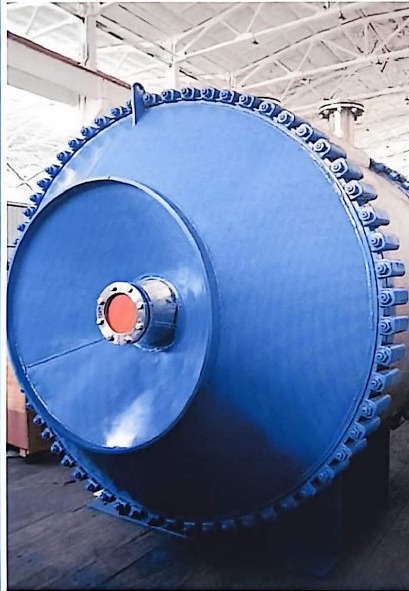
Spiral Plate Heat Exchanger
Counter-current spiral plate exchanger with tangential nozzles and uniform channel curvature — low resistance, high design velocity, effective even at small temperature differences.
Specifications
| Flow arrangement | Counter-current spiral channels |
|---|---|
| Channel count | Two channels |
| Constructions | Two-channel / detachable two-channel |
| Nozzle type | Tangential |
| Duty sizing | Engineered per media, flows and temperatures |
Product Detail
Spiral Plate Heat Exchanger: Counter-Current Flow in Two Spiral Channels
The spiral plate heat exchanger is formed by rolling two steel plates into two uniform spiral channels, so the two heat transfer media flow counter-currently through the body. This arrangement greatly strengthens the heat exchange: even when the temperature difference between the two media is small, the exchanger still reaches its intended transfer performance.
Why the flow resistance stays low
- Tangential nozzles. The nozzles on the shell use a tangential structure, reducing local resistance at the connections.
- Uniform curvature. Because the curvature of the spiral channels is even, the fluid flows through the equipment without large directional turns.
- Higher design velocity. The low total resistance allows a higher design flow velocity, which is what gives the exchanger its strong heat transfer capability.
Available constructions
The exchanger is supplied in a two-channel version and in a detachable two-channel version. The detachable construction opens the channels for inspection and cleaning where the process requires it.
Information to include when selecting
Spiral plate exchangers are sized from the duty, not from a catalogue table. For an accurate proposal, send the two media and their physical properties, the flow rates, the inlet and outlet temperatures, the operating pressures, and any fouling or solids content in the streams.
Frequently asked questions
Does it work with small temperature differences?
Yes. The counter-current spiral flow is designed to transfer heat effectively even when the two media are close in temperature.
Why choose the detachable version?
The detachable two-channel construction allows the channels to be opened for mechanical cleaning when the process media tend to foul.
Which materials are available?
The standard body is steel plate; confirm the material and thickness for your media with us at inquiry.
Request spiral plate heat exchanger details
Include both media, flow rates, inlet and outlet temperatures, operating pressures and any fouling tendency so we can prepare a sizing response.
Request product details